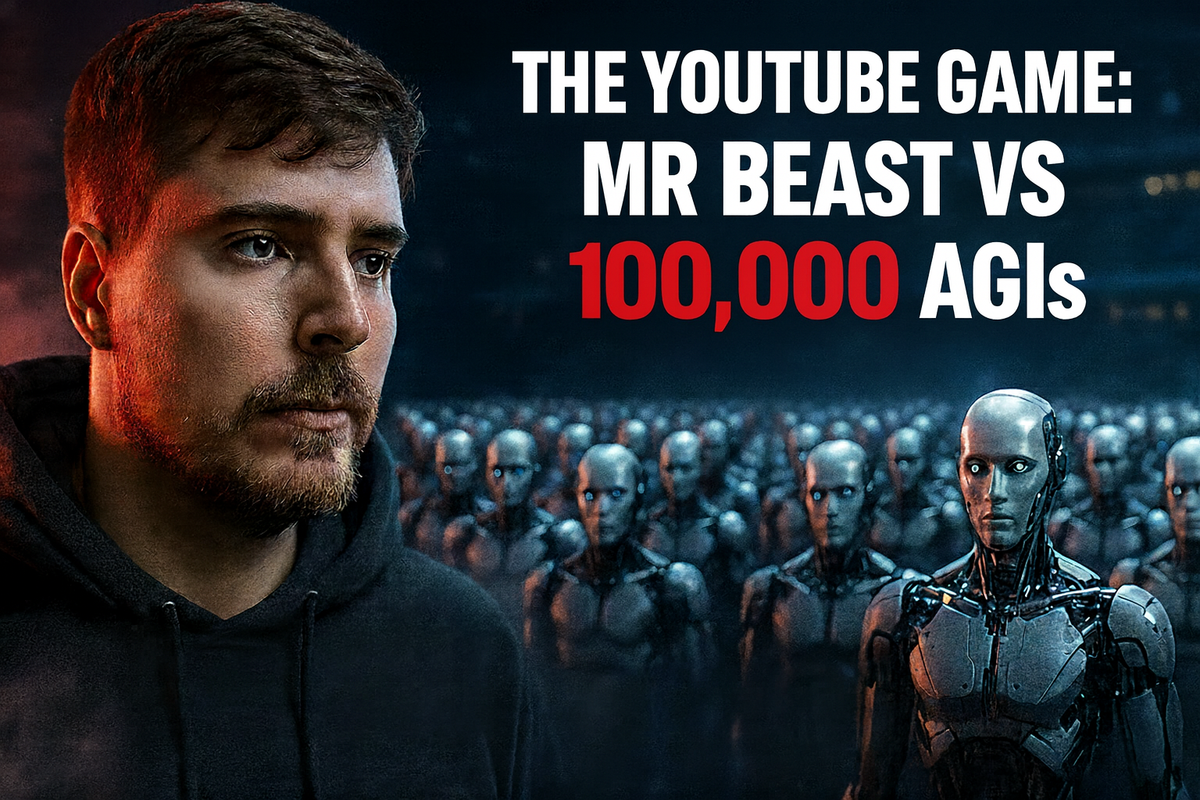
The YouTube Game: Mr Beast vs 100,000 AGIs
Would Mr Beast create more engaging videos than 100,000 AI copies of him?
What happens when we have an AGI smart enough to create videos as engaging as Mr Beast on YouTube?
And what happens when there are 100,000 instances of this AGI running, all trying to create videos more engaging than each other?
Which one ‘wins’?
The answer to these questions will answer an even more important question over the next few years:
What happens to digital service businesses when AGI can create videos, images, text and sound that is indistinguishable from reality? What happens when it can create all of the workflows that make up those businesses, and hyper optimise for a goal (maximise profit)?
I have been thinking about this for a long time now.
And I think I finally have an answer I’m confident in.
The person who spends the most capital wins.
WTF?
Are you confused?
Okay, let me backtrack and explain how I came to this conclusion.
What is intelligence?
It is the ability to make accurate models of the world - through search, program synthesis (solving problems with solutions), continual learning based on verifiable ground truth to change the graph of ‘knowledge’, and memory.
If that didn’t make any sense to you, then ignore it, and go with this much simpler definition:
Intelligence is prediction.
It’s the ability to accurately predict what might happen next.
Over and over and over again.
If you think about the smartest people you know, you’ll probably see some patterns: they have visions of the future that are different to everyone else and usually much more right than others.
Why is this?
It’s a combination of two things:
Firstly, they likely think about the future more than most people.
They spend many mental cycles thinking through different possibilities, stress testing them mentally, thinking about edge cases, and trying to understand how different scenarios trigger different possibilities.
Then what do they do?
They assess what they think is the most probable path.
But they don’t actually know what will happen in the future.
Why?
Because the only way to predict the future is to live it.
This sounds trite, but it really is not.
I’m trying to get you to understand a very specific point.
The future is non-deterministic.
Think about the future as a branching tree of possibilities.
Different paths on the tree each have an assigned probability of happening or not happening.
The only hope we have of influencing this tree is to take the set of actions that maximises the probability of moving towards the path we want.
Nothing is guaranteed.
Which brings me to the most important point:
Prediction requires computation.
You cannot predict which path will occur without computing it.
Stephen Wolfram refers to this as computational irreducibility, meaning if you have a set of causal events A → B → C → D, you cannot skip from event A to event D without running the computation of A & B & C first, in order.
This is a very simple idea, but extremely elegant, and it will explain what happens in the scenario we are heading towards:
What happens when we have an infinite supply of AGIs each capable of performing the same optimisation goal within a complex system?
If every AGI is given access to the same amount of starting capital in a complex system, we cannot know in advance which AGI will ‘win’ at the optimisation without first running the computation required.
The only way to know is to actually perform the computation.
And since computation requires money, the person with the most money to spend on it has the highest probability of winning.
Why?
Let’s take a look at an example.
I call this The YouTube Game: Mr Beast vs 100,000 AGIs.
Let’s say we have an AGI that is as capable as Mr Beast at creating highly engaging YouTube videos.
And let’s say there are 100,000 instances of each AGI, each with a compute budget of $500,000.
For example’s sake, let’s say the rules of the game are they can only create 1 video with their compute budget.
So what you end up with is 100,000 ‘engaging’ videos.
What happens if they are all uploaded at the same time, or within a very similar time period?
It’s an interesting thought experiment, because only one can win.
Only one can have the most views, the longest watch time, most likes, etc.
Which one wins?
Can you guess?
We cannot know without running the experiment.
It is unknowable.
The computation has to be done; the money has to be spent - this is the only way to find out.
Okay, so why is this important?
It is important because the implication of this is that the person who has the most money to spend on compute wins.
Because that person can adopt three viable strategies to increase the probability of winning: 1) create more videos: the more videos you create the higher the probability of that video being the most engaging, or 2) spend more money on a single video: the more compute you allocate to a single video the higher the quality, and therefore the better the probability it may be perceived as engaging, or 3) a combination of both 1 and 2.
Do you get it yet?
If all 100,000 videos are equally ‘engaging’ in simulacra (before uploading), the easiest way to have the most engaging video is to flood YouTube with as many of them as possible, within the constraints of the algorithm (to avoid being perceived as spam).
If you were responsible for 50,000 of those videos and they were all Mr Beast level quality, you have a much better chance of being the winner than if you only had 1.
But using computation to create 50,000 engaging videos will cost lots of money.
So the winner is the person with the most money to spend on compute!
Content creators (pre-AGI) frequently say that you need consistently high quality content to increase your chances of going viral.
Well, AGI will be able to create consistently high quality content, which will render human effort obsolete.
In the end state of this AGI world, capital to spend on compute is the only thing that will matter.
The other important point here is that human attention is the real bottleneck, and what is ‘engaging’ is itself malleable - subject to change over time.
I’d like to emphasise one other thing: the reason the computation has to be performed - the reason you cannot skip from A to D and simulate which video will be most engaging before uploading it - is because the participants of the system, and the system itself are chaotic, complex systems.
Namely, humans (those that supply the attention to watch your video) and AI (the algorithm that determines what video to show to whom and when) interact in ways that cannot be predicted in advance.
This is why you cannot create viral content without actually uploading the content to see if it goes viral. You cannot simulate virality, because you cannot approximate how the real system will behave - it’s non-deterministic.
Humans are general intelligences, and general intelligences can always decide ‘no, I’m not going to do the thing I normally always do today - I’m going to do something completely different and random instead.’ It is unpredictable, like us.
The best you can do is run the computation and find out.
I know I am being repetitive now - it’s on purpose.
Because I am trying to drill into you how a very simple idea can be used to extrapolate something much deeper, which I believe will be true, about AGI:
All digital service businesses in the future will look more like hedge funds and high frequency trading firms than agencies.
Why?
Well, if you’ve been following my reasoning so far, you should already know:
Because hedge funds have the most money and the easiest access to capital.
And capital wins.
Capital doesn’t just win ‘The YouTube Game’ - it wins every game.
Which means capitalism, at least in its current form, is unlikely to survive AGI.