Meta Slopbox: Vibes Are Off
The next evolution of social media algorithms is pure slop
What if I told you there exists a box that contains so much slop, that if you dare take even a small peek inside it, you may just be enslaved to its sins for all eternity.
The box I am talking about, of course, is the Meta Slopbox, which they unironically call ‘Vibes’.
Today, Meta released their new vision for an immaculate, vibey future:
Infinity Tiktok-esque short form video content, generated with AI.
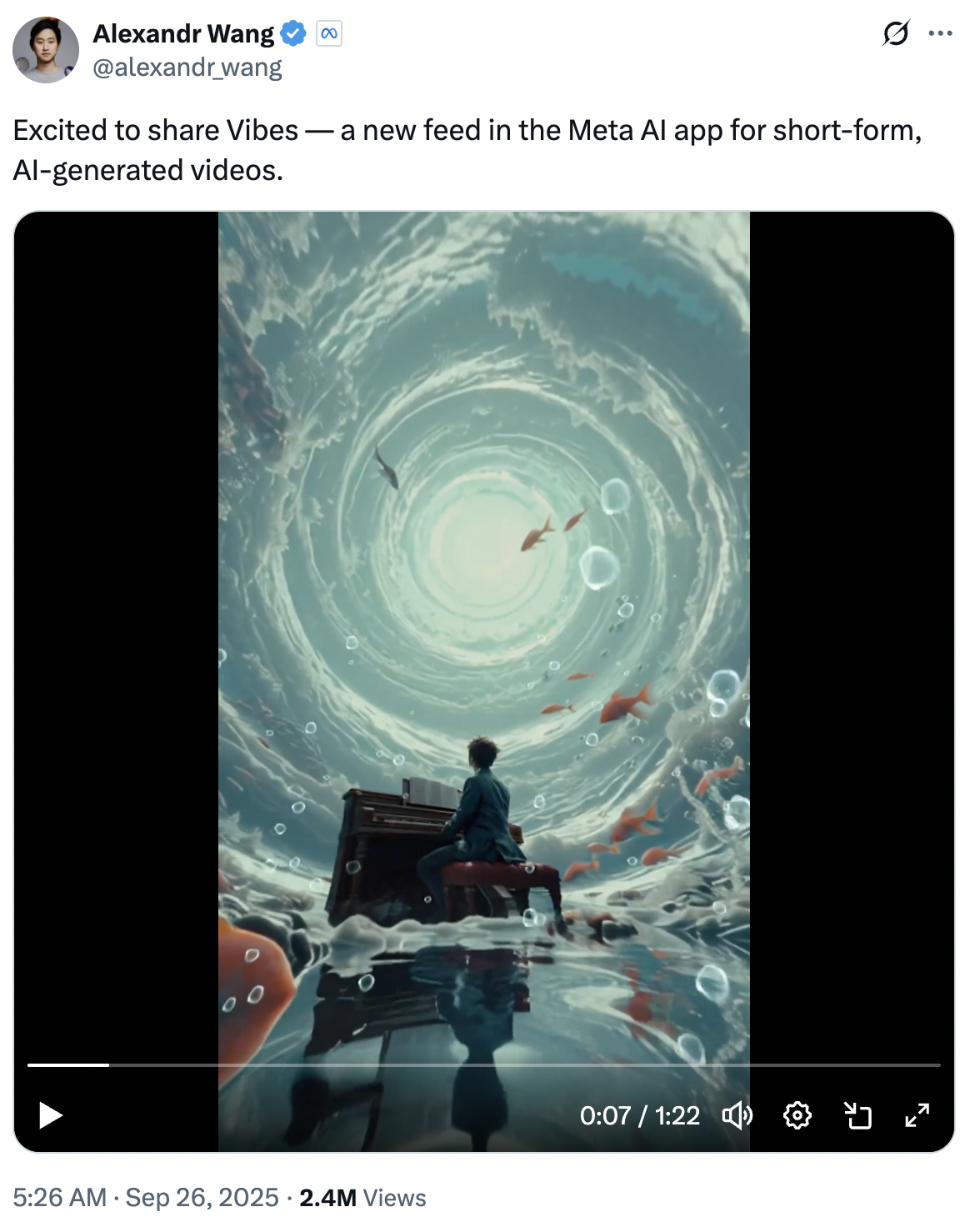
Such innovation.
All I can say about this is the following:
Run, far, far away from whatever TF this thing is.
If you want to spend your life consuming AI slop, your entire life will become slop.
You’ll look at the slop, you’ll laugh at the slop, you’ll share the slop with friends, and before you know it, you’ll be creating the slop yourself - via the Meta AI app.
And just like that, you’ll be a victim to the Slopbox.
You know the quote
“No man ever steps in the same river twice, for it’s not the same river and he’s not the same man.”
Well, how about a variation:
“No man ever views the same slop twice, for it’s not the same slop and he’s not the same man.”
This stuff is brainrot, digital crack cocaine.
There’s a couple of specific points I would like to make about the Meta Slopbox, which apply to the ongoing AI landscape, but in order to properly explain this I need to first take a step back and speak about social media network effects.
In order to bootstrap a social network you need some way to solve the cold start problem, which is: how do you get users if there’s no content, and how do you get content if there’s no users?
In other words, how do you build and retain a dense network of users?
Solving the cold start problem leads to a network effect, whereby the network accrues value in proportion to each extra user that signs up and uses the platform.
It is the network effect that makes Facebook, TikTok, Instagram, etc valuable - NOT the software per se.
Facebook built its network effect by going deep (not wide) in terms of go to market strategy, targeting college students on campuses.
Instagram built its network effect by piggy backing off of Facebook’s already existing distribution - in the early days, every post by a user on Instagram would automatically post on Facebook too.
This enabled Instagram to grab the attention of the entire existing network of users on Facebook and funnel them to Instagram instead - a smart strategy for viral growth back when social media algorithms were dominated by social content instead of algorithmic content (recommendation algorithms).
A network’s value comes from a number of things, depending on the network, but generally speaking it needs constant content generated from its users to sustain value, else the network becomes stale.
Anyway, why am I telling you about network effects?
And how does it link back to the Meta Slopbox they call Vibes?
Well, we sit on the cusp of yet another change in how social media algorithms will disseminate content on their networks.
We started with the social graph - you see what your friends post, in chronological order.
Then we moved to the interest graph - where algorithms determine what content you see, based on your interactions and engagement with the content produced in the app.
Now, we are about to move to the ‘AI graph’ - where AI itself produces content, and determines what content you see.
It’s the purest form of algorithm, and will be the most addictive, by far.
Let me explain why.
When you go on YouTube, or TikTok, or Instagram, or Twitter, you have certain people you follow who you like more than others.
You choose to follow these people, because you like their content.
But they don’t post all the time.
They post frequently, but it’s not 24/7.
And in order to incentivise these people to post at all, most social media networks have to have some implicit or explicit promise that there is actually something in it for the creators: money, or attention.
So some creators who are good at what they do get paid - either by the network themselves or by leveraging their audience to sell things.
You can think of this like a ‘tax’ for the social media networks.
It’s a necessary evil.
They need the users to create the content, else their network value atrophies over time, which hurts their business value because the content is used to sell advertisements - the primary revenue stream for most of them - which in turn impacts the business’s valuation.
But what if there was a way to avoid this tax?
What if there was an entirely new way to bootstrap a social network, without creators?
And what if it was the most addictive network ever created?
The stickiest product in human existence.
That’s exactly what the aim of the Meta Slopbox is.
Today, it offers Meta AI users the ability to produce AI slop, that gets put into the ‘Vibes’ feed.
But tomorrow, the AI algorithm itself will produce all the content, and tailor it specifically to what it learns you engage most with.
If you’ve been following my writing so far, you’ll realise there’s a few ways to spot trends before everyone else, and one that I have now mentioned a couple of times is this idea of ‘disintermediation’: new technology often disintermediates something else, making it more efficient and dense.
What’s being disintermediated here is the human content creators.
Why would you pay for a human content creator on an AI video app when you can have an AI model first learn what the user likes, and then produce exactly what they like using AI, 24/7 at the cost of compute (not the cost of human labour).
It’s a complete no-brainer.
The Meta AI ‘vision’ of humans contributing to this slopbox is nothing but a distraction from the broader goal, which is to create the stickiest short form video app ever produced, by creating an AI graph - not an interest graph, and not a social graph - but a graph that is entirely AI-driven both in terms of learning what is engaging and then producing engaging content directly.
Taking a step back for a moment, what does this mean for the future?
What trends can we extrapolate from this understanding, and might you profit from it?
My main takeaways so far are the following: